Solid Ground Newsletter
September 2026
This Month’s Issue
Livestock Fencing Installation Skill Share
Need some help before you install some electric fencing on your farm?
We’ve got you covered! 🐄⚡
Saturday, September 19th | 9am – 1pm
Peaceful Valley Farm, Dayville, CT
Learn the fundamentals of electric fencing from Heather Gooden of Gallagher Animal Management and get guidance on regulations, safety, and funding from MacKenzie White, Diversified Livestock Specialist with UConn Extension. Practice cutting, splicing, and tightening fence line — plus connect with fellow farmers!
Perfect for beginning farmers ready to tackle their next fencing project with confidence.

September Task: Getting to Know Your Soil pH
An excerpt from the article “Soil pH as an IPM Tool for Disease Management” published in the September Crop Talk. The full article was written by Avishesh Neupane, Assistant Extension Professor, Department of Plant Science and Landscape Architecture and Shuresh Ghimire, Vegetable IPM Specialist, UConn Extension.
Off-target pH often shows up first as weak, yellow, uneven growth, and those areas commonly become the first disease hotspots. pH can limit root function and nutrient uptake, so plants run nutrient-stressed even when soil test levels look adequate. Crops also differ, so a pH that works fine for one crop can cause hidden nutrient stress in another. That stress doesn’t cause disease by itself, but it lowers plant tolerance and slows recovery once infection starts. Soil pH can also shift the soil microbiome in ways that reduce natural pathogen suppression. Soil acidification has been shown to weaken microbiome suppression of Fusarium, for example, allowing more disease under the same pathogen pressure and pH is a major driver of microbial community structure and function. The good news is pH is measurable and fixable, but it takes planning.
Tips to treat pH like prevention
- Use crop-specific pH targets.
There isn’t one ideal pH for every crop. Many vegetables, flowers, and turf do well in moderately acidic to near-neutral soils, while blueberries and other acid-loving plants need a lower pH. UConn’s Plant pH Preferences webpage lists recommended pH ranges by group. Start with the crop, then adjust pH based on field history. - Manage by zones when possible.
pH can vary widely within a field due to soil type, past manure, knolls vs. low areas, and liming history. The most practical approach is to sample by management zones, map pH, and then apply lime (or sulfur, when needed) where the test shows it is required. If variable-rate application is not an option, you can still do zone management by targeting problem areas such as wet spots, sandy knolls, field edges, or specific blocks that consistently test low or high. In strip-till or bedded systems, banding lime in the worked zone helps correct pH where most roots grow. In high tunnels and drip-irrigated blocks, manage pH at the bed or tunnel level. Adjust lime or sulfur rates by tunnel or bed based on testing, and if pH keeps drifting up over time, consider testing irrigation water alkalinity and managing it where feasible. - Plan changes early.
Lime and sulfur take time to work. Limestone can take months to fully react, and it moves slowly downward in soil, so it is better to plan ahead than to try to fix pH midseason. - Do not compensate with extra fertilizer during disease pressure.
If pH is off, nutrients may not be taken up well. Adding more fertilizer can increase salt stress and push soft growth that is harder to protect. Confirm the pH issue with a soil test, keep fertility steady, and time pH correction so the crop is in range before the next critical stage. - When symptoms show up, compare a good area and a problem area.
If you see yellowing or patchy stunting, sample both: soil test and tissue test from a good zone and a bad zone. That helps you tell the difference between low nutrients in the soil and nutrients that are present but not being taken up.
Bottom line
Keeping pH in the right range helps crops take up nutrients, build stronger roots, and handle disease pressure better. It does not replace scouting or other IPM steps, but it makes them work more reliably and reduces problems in the weakest parts of the field.
You can learn more from the Integrated Pest Management (IPM) Team at UConn Extension through their quarterly Crop Talk e-newsletters.
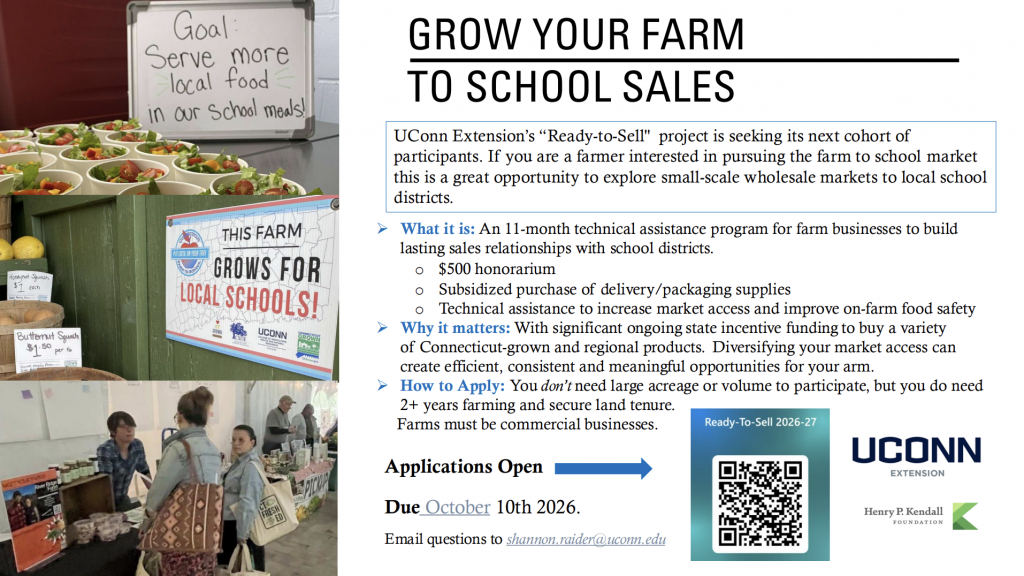
Get Connected with CT Farm To School
- Get Listed: Join the CT Farm to School Directory and Marketplace-Listserv
This interactive resource identifies farms throughout the state who are ready and eager to sell to schools. School Food Service Directors frequent this resource to find farms to purchase from.
- Learn More: Apply to join “Ready To Sell” farmer training cohort
Participants in Ready to Sell learn about school buyer expectations, forward contracts, food safety considerations, and more. Get specialized technical assistance to up your school sales game. Learn more and apply here!
- Save the Date: October 5-9 is 2026 CT Grown for CT Kids Week
October is National Farm to School Month, so naturally, the first full week in October is CT Grown for CT Kids Week when schools celebrate local agriculture, local food education, and strengthen their commitment to healthy nutritious meals with locally grown ingredients. Be part of it!
CT Grown Organic Corner
Transitioning and certified organic producers located in CT can get Technical Assistance from Dave Tschiegg, Organic Outreach Specialist
Dave Tschiegg is the Organic Outreach Specialist in partnership with UConn Extension, CT NOFA, and the Connecticut Department of Agriculture. He supports transitioning and certified organic farms in growing their presence in the organic market through one-on-one, in-person marketing assistance and alignment with the forthcoming CT Grown Organic campaign. He looks forward to meeting farmers where they are to help grow their businesses through creative, strategic marketing.
Technical Assistance Services
- Guidance on participating in the CT Grown certified organic campaign and related promotional opportunities
- Technical assistance implementing CT Grown certified organic brand and marketing assets
- Share insights from organic consumer research report to support market growth and customer engagement
- Evaluate current marketing strategies and materials
- Make recommendations for enhancing brand messaging and storytelling around certified organic status and products
- Assess website and social media presence
Apply for the Connecticut Agricultural Composting Program

CT RC&D is accepting applications for a new composting program! The CT Agricultural Composting Program is here to help farmers and agricultural producers gain knowledge and tools to develop a successful on-farm composting system.
Program opportunities include:
- Educational resources and training
- Technical assistance
- Grant opportunities
Whether you’re considering agricultural composting for the first time or looking to strengthen an existing operation, we’re here to help. Learn more about this new program, available resources, and how to get involved.

Upcoming Events
- Livestock Fencing Installation Skill Share
September 19, 9AM to 1PM
Peaceful Valley Farm, Dayville - Tractor Maintenance Training
October 21, 3PM to 6PM
UConn Research Farm, Storrs - Farmland Seeking Skill Share
**Has Been Canceled** - Intro to Grants for Farmers
October 30th, 8:30AM to 12PM
New London County Extension Office, Norwich
Partner Events
- Eastern CT CRAFT Farm Tour & Discussion on Compost & Microscopy
Date: September 21, 4PM to 6PM
Location: Assawaga Farm, Putnum - Cover Crop Termination Event
Date: September 23, 3:30PM to 5:30PM
Location: UConn Research Farm, Storrs - Connecticut Agricultural Composting Program
Application Due Date: September 30 - New England Vegetable & Fruit Conference
Dates: Dec 15, 16, 17
Location: Manchester, New Hampshire
Save these Dates
- 2026 New England Vegetable & Fruit Conference
Dec 15-17, Manchester, NH - UConn Extension Annual Vegetable and Small Fruit Growers Conference
Jan 12, 2027, Storrs, CT - Solid Ground’s Farm Managers Summit
Jan 20, 2027, Hartford, CT
Free Consultations
Just a friendly reminder that Solid Ground offers FREE consultations from UConn Extension professionals to help support your farm operations. Whether they’re coming out to your farm, chatting with you over the phone, or communicating with you via email, our consultants are here to help you tackle the challenges you are facing:
- Commercial Vegetable and Hemp Specialist, Shuresh Ghimire
- Commercial Fruit Specialist, Evan Lentz
- Diversified Livestock Extension Specialist, MacKenzie White
- Soil Health Specialist, Amelia Magistrali
- Soil, Conservation, and Land Use Consultant, Kip Kolesinskas
- Urban Agriculture Educator,
Jacqueline Kowalski - Certified Organic Marketing TA,
Dave Tschiegg - Farm to School Partnerships,
Shannon Raider-Ginsburg - Farm Viability Services, Diane Dorfer
- One Health, Sara Tomis
If you require an accommodation to participate in any of our events, please contact Nicole Davidow, Solid Ground Event Coordinator, at nicole.davidow@uconn.edu at least 5 days in advance of the event or program.